At the beginning of a contract everything often goes swimmingly. The client loves you and you get paid on time, every time. Then, after a few issues or delays, the contract can go a little bit off the rails.

There’s issues to do with deliverables, the client is a bit late in paying bills, and there’s arguments about bugs. You try and negotiate your way through, but after a while the relationship begins to break down and you find yourself owed a lot of money, with claims from the customer that you are delivering a half-built app. Where to from here? Finish the app and hope that you get paid in the end? March off to court? Or just let the whole thing slide and leave with a bitter taste in your mouth? Does working in Agile or Scrum deliver any benefits to software developers? Software Developers know about a Minimum Viable Product, what’s a Minimum Viable Contract?

If you have concerns about contracts and contract laws, or if you’re just curious about the legal side of software development and working with clients, watch this video as it might be the best free advice you’ll ever get from a solicitor!

Note

This presentation is intended to provide commentary and general information and should not be relied upon as legal advice. Formal legal advice should be sought in particular transactions or on matters of interest arising from this presentation.

Take the Quiz!

[WATUPRO 1]

About the speakers

About the speakers

The Enforcer

Cameron Shaw was admitted as a lawyer of the Supreme Court of New South Wales in 2011.
Cameron spent seven years in project management, sales and management in the software and finance industries before entering the legal profession.
He has recently run matters in the Supreme Court on mutual wills and family provision, charitable trusts and the Contracts Review Act.
Cameron is also a Director of a not-for-profit aged care provider.

Related videos

Related videos

Treat Your Code Like Uranium | Adam Cogan

Adam Cogan shares a striking story comparing two World War II factories—one ordinary, one handling uranium—and the surprising lesson that the uranium workers lived longer because they followed disciplined, risk-aware practices. He connects that idea to software teams: the best outcomes come from careful habits like automated tests, telemetry, pull requests, retrospectives, shared rules, and good tools. The message is simple: treat software delivery with the same respect as dangerous work, and you’ll reduce stress, avoid chaos, and get better results.

3 Tips for Better Video Recordings | Adam Cogan

Great coaching can dramatically improve how you present, communicate, and learn. In this video, Adam Cogan shares 3 practical coaching tips that SSW uses every day—from onboarding and role plays to improving video delivery. He explains why having a coach matters, why immediate interruption beats delayed feedback, and how repeating corrections helps lock in better habits.

TinaCMS + Fumadocs: Bring Visual Editing to Your Docs | Hark Singh

Discover how to connect Playwright with AI agents and unlock powerful workflows.

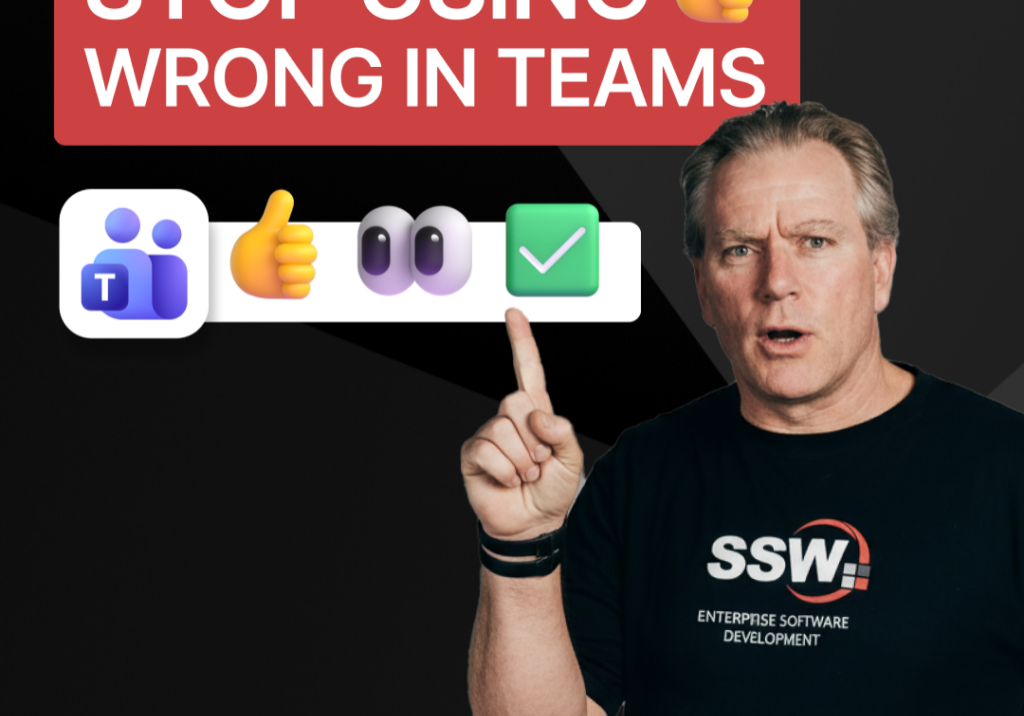
Stop Using 👍 Wrong in Teams | Adam Cogan

A quick communication tip from Adam Cogan: don’t use 👍 as a catch-all response when someone assigns you a task in Teams, Slack, or Google Chat. In the example Adam gives, if a task will take about five minutes, a thumbs up is too ambiguous because it does not clearly say whether you’ve read it, agree with it, are doing it now, or will do it later. Instead, use 👍 for agreement, 👀 to show you’ve seen the task and are actively working on it, and then replace 👀 with ✅ once the task is done. It is a small change, but it removes ambiguity and cuts down unnecessary follow-up messages.

How to record a done video in SSW | Sylvia Huang | SSW Rules

Sylvia Huang from SSW shares her SSW Cultural Exchange experience from Hangzhou, China to Australia

4 Essential Sales Tips for Engineers | Adam Cogan

Not a salesman? No problem. Adam Cogan shares 4 practical tips to help engineers navigate sales meetings with confidence. Learn how to stop “selling” and start solving, how to talk numbers without the awkwardness, and why being transparent about your process wins more clients.

Do you explain why you’ve deleted or updated an appointment? | Adam Cogan | SSW Rules

Ever wonder why a meeting was moved or cancelled? Adam Cogan explains the “Secret Ingredient” to professional scheduling: always include a version history and reason for change at the top of your appointments. Improve clarity, keep a record of changes, and hold participants accountable with this simple SSW Rule.

Chat first before changing others’ code | Adam Cogan

Changing someone else’s code? Don’t just dive in! Adam explains why it’s important to check the source history and talk to the original developer before making changes. A quick chat can save headaches and keep everyone on the same page. Perfect advice for devs working in teams!

SSW TimePro – Create a new tenant | Jeoffrey Fischer

Learn how to provision a new tenant in TimePro and sync it with an external Dynamics 365 CRM system.

How to Report Bugs in Seconds | Brady Stroud

Tired of tedious bug reporting? Watch how Brady uses YakShaver.ai to turn a quick screen recording into a professional PBI instantly.